• Before World War I, we are told, Europeans could travel throughout the Continent without passports.  The same was true of North America before 9/11.  All an Americans needed to enter Canada was a rabies vaccination certificate for their dog, if they had one.  All they needed to get back was to state where they were born.  “POTS-dam, New York,” my mother would sing out.  “Germany!” my grandfather would growl.  Was he a U.S. citizen? the border guards would ask.  “Since before you were born, Sonny!” he would retort.  Then as now, border guards do not like being trifled with, and invariably they would pull him over, but all they could do was waste his time.  

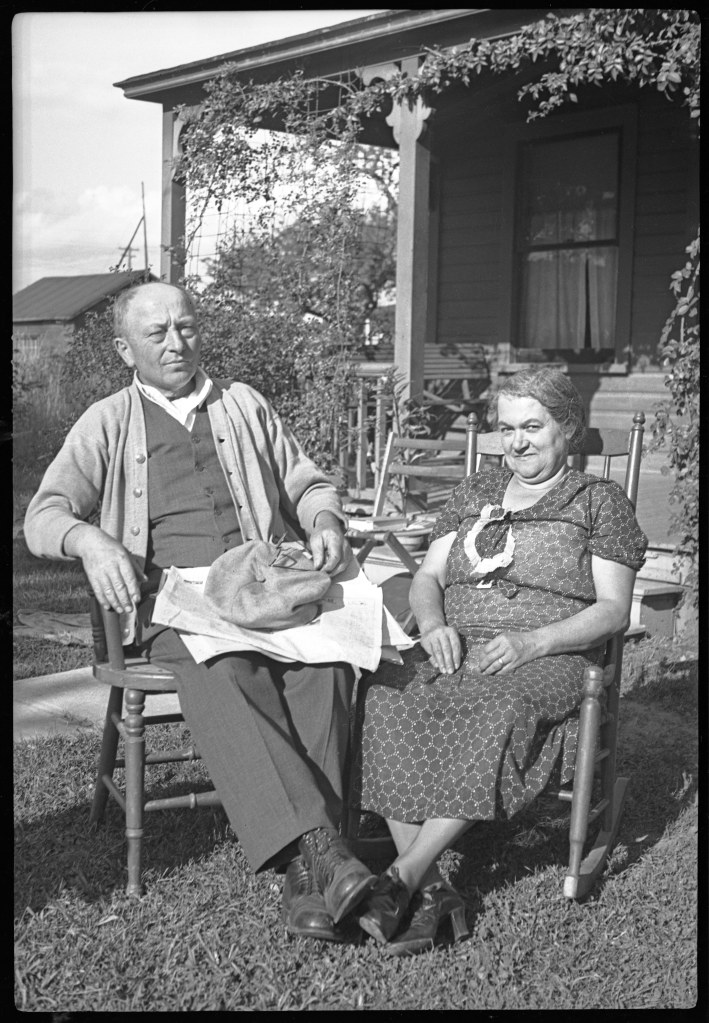
    Ma and Pa Geist in front of their cottage in Crystal Beach, 1930’s

                      My father grew up in Buffalo, a border town in a border state.  After his mother suffered a nervous breakdown subsequent to bearing her eighth child, his father, the above-mentioned smart aleck, bought her a cottage, sight-unseen, in Crystal Beach, Ontario, a vacation destination on Lake Erie for working class Buffalo.  Crystal Beach boasted one of the most perfect swimming beaches on any of the Great Lakes, and next to it stood an early 20th century midway with a multiplicity of rides, including a Ferris wheel, roller coaster, boats that floated through enchanted tunnels, and a miniature train.  

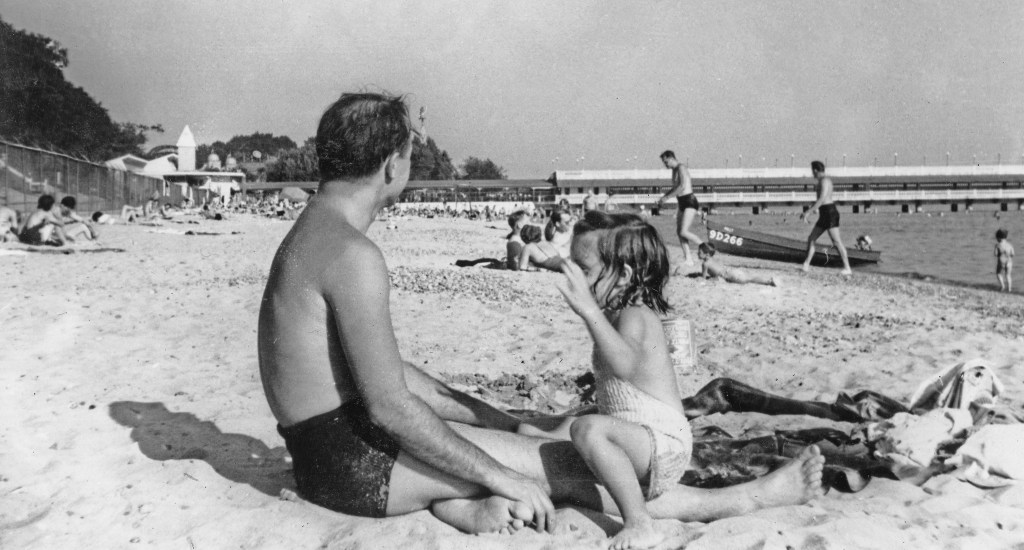
    My sister Gretel with her Uncle Otto at Crystal Beach, 1940’s; the pier for the “Beach Boat” is visible to the right and the midway in the upper left.

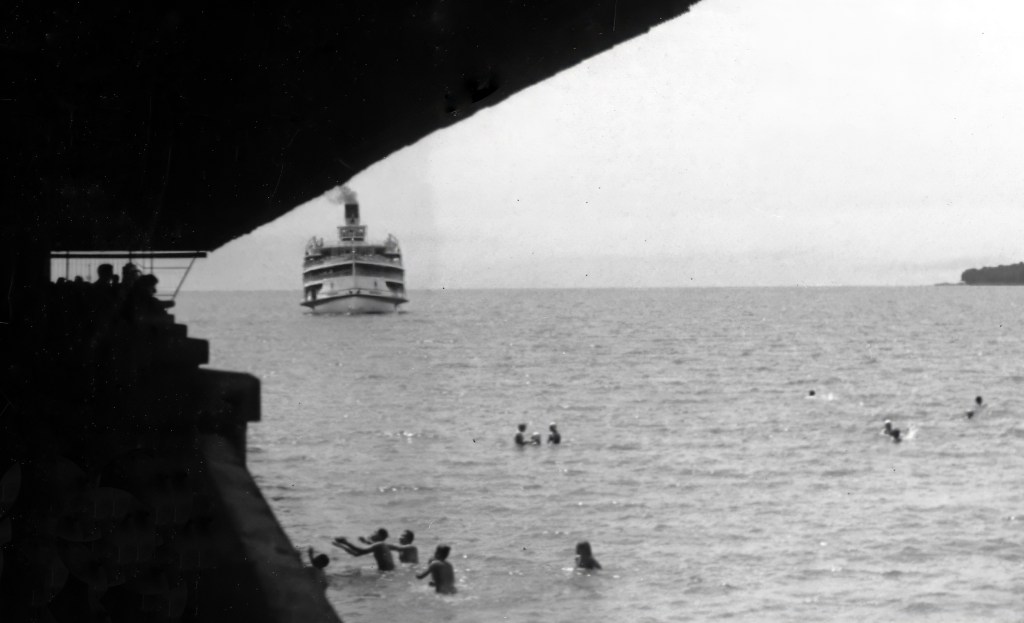
    Until the late 1950s, one had only to hop onto the “Beach Boat” to get from Buffalo to Crystal Beach by ferry.  It docked at a long pier that stretched out along the midway side of the beach where it remained for scores of years after the ferry had ceased operations.

    The “Beach Boat” ferried passengers between Buffalo and Crystal Beach.

                      Alternatively, one could reach Crystal Beach by train via Ridgeway, a nearby town that also catered to tourists from the States.  My grandfather, I’m told, would take the train to Ridgeway and, on his walk to the cottage, buy gladiolas for his wife, who spent her summers there while he stayed in the city to work.  

                      Ridgeway had its own magic.  In the 1950s, Canada was still part of the Commonwealth.  A faux timber-frame Tudoresque building housed an extensive store offering goods from the Commonwealth: English china, Scottish woolens, koala bear stuffies (although we didn’t use that term back then), and children’s books that featured koala bears, kangaroos, and other exotic creatures from Australia.  Other stores featured English toffees, and a drugstore, named Brodies, offered ice cream sodas in flavors we couldn’t get at home.

    China from Ridgeway

                      Home was Michigan, where my father landed a job soon after the end of World War II, and every summer we trekked to Buffalo/Crystal Beach, first by bus and later by car, across the part of Canada that stretches down between Lake Huron and Lake Erie.  A succession of bridges connects the two countries, the Ambassador Bridge (Detroit/Windsor), the Bluewater Bridge (Port Huron/ Sarnia), the Peace Bridge (Buffalo/Fort Erie), the Rainbow Bridge (Niagara Falls, both sides), to name a few.

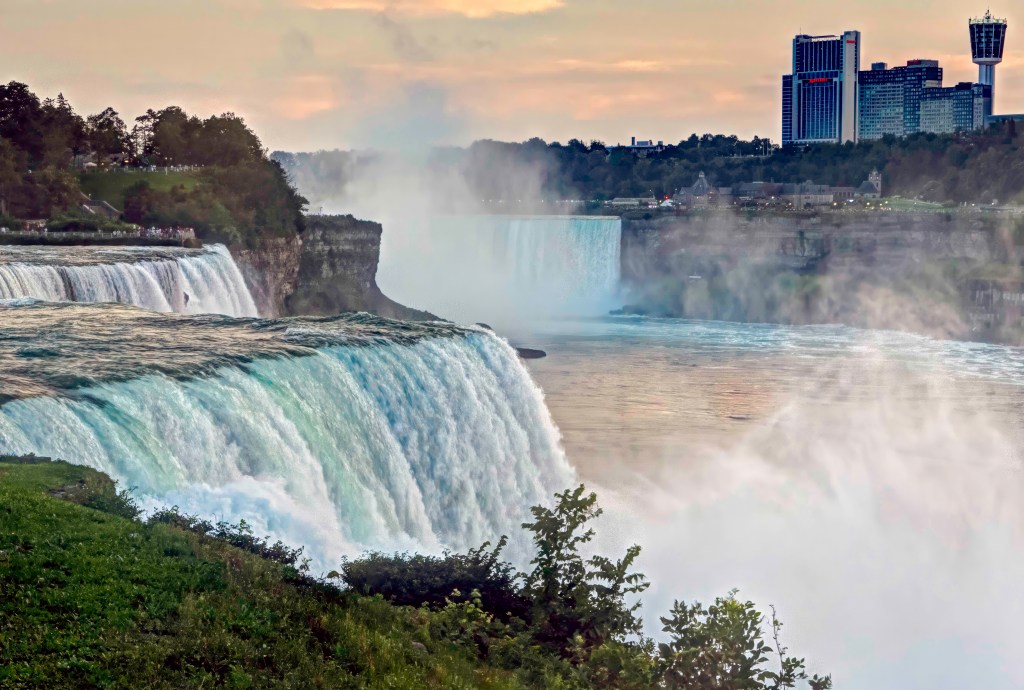
                      World famous Niagara Falls spans the Niagara River between the U.S. and Canada; the most beautiful views are on the Canadian side.  Every summer included an evening visit to the Falls, where we watched colored lights projected onto the tumbling water.  A barge, stuck on the rocks above the falls since 1918, inspired its own wonder.  Out of control and heading for disaster, it moored on rocks near the Canadian shore, some 766 meters short of the water raging over the 50 meter drop.  Fearing it would soon dislodge, crews using ropes hastened to rescue the two men aboard, but for one hundred years the barge never left its resting place;  in 2019 it finally shifted and began to break apart.

    Niagara Falls from the American side, looking toward Canada. Photo Steven Sternbach

                      As an adult I’ve ranged further than Crystal Beach in eastern Canada: the 1967 Montreal Expo, academic meetings in Montreal and Toronto, camping on Lake Superior and in Lake Huron on Manitoulin Island, visits to the Ottawa Valley and the Thousand Islands in the Saint Lawrence Seaway, a week on Campobello Island, off the coast of Maine, in 2017,  the year Canada celebrated 150 years of independence from Great Britain. 

    Campobello Island, 2017. Photo Steven Sternbach

    Of the ten places their readers most want to visit, the New York Times finds that a rail trip through the Canadian Rockies is number one.  My parents took that trip.  My husband and I would love to follow (but it has gotten very expensive). 

                      As a child I travelled to Canada to visit my cousins, and Canada itself seemed like a cousin, a “foreign” country that did not seem foreign at all, just a little bit different: different money, with almost the same value, an obsession with maple leaves, French everywhere, and, back in the day, a touch of England.  I never dreamed my own country would elect a boorish chief executive who would troll, demean and try to damage Canada.  At a very visceral level, Canada is family.  

                      In 2025, the Canadians dedicated the brand new Gordie Howe International Bridge, which crosses the Detroit River between Windsor and Detroit.  The span between its support towers is the longest for a cable-stayed bridge in North America and among the longest in the world, a show of faith in the future of Canadian/U.S. mutuality and support.  The bridge is named for Gordie Howe, a Canadian hockey star who played for the Detroit Red Wings, symbol of the symbiosis between the United States and Canada. Our churlish chief executive, determined to destroy all that is righteous, good, and beautiful, has threatened to prevent the bridge from opening, but Michigan’s governor insists otherwise. Chief executives come and go.  The bond between Canada and the United States may be assured by treaties and ruptured by indecent political actors, but it lives on in the hearts of its peoples, and it will endure.  

  • James Vanderbilt’s Nuremburg looks at a lesser-known aspect of the famous war crimes trials, focusing on the role of psychiatrist Douglas Kelley (Rami Malek), charged with probing the personalities of high-ranking Nazi defendants and keeping them alive, i.e. preventing them from committing suicide.  The film probes in particular, Kelley’s relationship with Hermann Goering (Russell Crowe).  When Goering’s strong and charming personality begins to overwhelm Kelley, another psychiatrist is brought in and, eventually, Kelley is relieved of his duties altogether.  A conversation with his interpreter Howie Triest (Leo Woodall), a fair-haired, Munich-born Jew and only member of his family to escape to America, reminds Kelley why the trials are being held in the first place, and, turning over his notes to lead prosecutor Robert Jackson (Michael Shannon), he returns to observe the proceedings.  In the course of the trial, a lengthy and gruesome film depicting the dead and dying in numerous concentration camps is shown, cementing the Allies’ case against the Nazi officials, but Jackson, nevertheless, falters in cross-examining the wily, defensive Goering. British assistant prosecutor Maxwell Fyfe (Richard E. Grant) steps in and draws Goering into admitting his undying loyalty to Adolf Hitler.  Goering is convicted, but, elusive to the end, succeeds in committing suicide, thus avoiding the ignominy of being hanged.  Kelley writes a book about his experiences, and the film ends with him arguing with a broadcaster over his thesis that the Germans were not uniquely evil, but that a Holocaust could happen anywhere, even in America.

                      This last scene confirms one’s suspicion that the film is intended as agit-prop as much as a retelling of a lesser known bit of history, a reminder that ordinary people can get swept up into an evil system when a strong and unscrupulous personality finds its way into power, that free and fair elections may nevertheless produce such an aberration, and that the “rule of law” may mean the rule of unjust laws.  Justice, the film reminds us, is never guaranteed.

                      The film is peppered with anachronistic language.  “No pressure,” to “own [a situation],” to “eat [someone] for lunch,” to “trash [something],” meaning to say bad things about it, are a few of the expressions included in the dialogue that were never used in the 1940s.  One has to wonder if the filmmaker, who also wrote the script, was simply unaware or if he included these to intensify the impression that this story could be taking place today, or someday soon, if we’re not careful.

  • Wim Wenders’ first narrative feature to be nominated for an Academy Award, Perfect Days is beautifully shot and perfectly edited but is not the perfect film some have dubbed it as it often feels flat in its repetitiveness, too much like Groundhog Day.  Despite the benign satisfaction that protagonist Hirayama, so named for the many Hirayamas in Ozu’s films, takes in his daily routine, he is an elderly version of the lonely, isolated, alienated young men who can relate to children but are terrified of women that populate Wenders’ early films.  Wenders, in fact, includes deliberate references to those films.  Like Bruno in Kings of the Road (Im Lauf der Zeit, 1976), Hirayama reads Faulkner, and on his last trip to his local bookstore, he purchases a novel by Patricia Highsmith, whose Ripley’s Game was adapted by Wenders to become The American Friend (Der amerikanische Freund, 1977).  (The bookstore which Hirayama visits repeatedly may itself be a nod to Hou Hsiao-hsien’s Café Lumière [2003], another less than inspiring attempt to channel Ozu.) 

    Hirayama photographs routinely with a now-archaic, small, point-and-shoot film camera, heir to Philip’s exploration of all manner of photography in Alice in the Cities (Alice in den Städten, 1974), and he listens to rock music from the 1960s and 70s like all of Wenders’ characters from that era.  Hirayama’s music comes from his large collection of cassette tapes, another throwback to the 20th century, while the diegetic rock music in the early films generally came from the radio.

    Perfect Days ends almost exactly as Kings of the Road does.  A close-up of Hirayama driving his van, while Nina Simone’s rendition of Feeling Good (which originated in the 1964 musical The Roar of the Greasepaint—the Smell of the Crowd) blares on the sound track, echoes Kings, which ends with a close-up of Bruno driving while Roger Miller’s 1964 ballad King of the Road plays.  The “protagonist” in both sixties ballads is an outsider who sings of life apart from the constraints of society.  The only difference in these two final sequences is that the shot of Hirayama is severely frontal while that of Bruno is lateral.  The severity in the framing and cutting in Perfect Days may be another homage to Ozu, but it also reflects the severity of the life choices Hirayama has made.

    Unlike Wenders’ early films, which were road movies—messy, energetic and pressing forward, despite having little in the way of plot—Perfect Days has a cyclical structure, intended, perhaps, to evoke Ozu, but also in keeping with the fact that Hirayama, as an older man, has settled on his life choices and adopted a routine that varies little from day to day.

    The protagonists in Wenders’ early films struggle against history, American hegemony, and bourgeois conformity, but similar struggles, primarily against the salaryman life expected of middle class Japanese men, are in Hirayama’s past.  He has broken with his family.  We are told his father stopped speaking to him—reminiscent of the confrontation between Robert and his father in Kings—and now the father has dementia, but Hirayama still refuses to visit him.  This refusal, along with the visit from his niece and sister, are the only indications that Hirayama is still processing the alienation that drove him to become a toilet cleaner.  Otherwise, his life is composed of set routines that seem to please him but which render the film rather dull.  Perfect Days attempts to capture a kind of Zen stasis, the mu that Ozu so treasured, but mu, often translated as nothingness, indicates a nothingness that is the gateway to sublimity.  The nothingness in Perfect Days—despite brief interludes of pathos, charm and humor—seems mostly to be just nothingness.


  • Conclave

    We were rooting for Conclave to win Best Picture, but dark horse Anora, which we hadn’t yet seen by Oscar night, won instead.  On the surface they couldn’t be more different.  Staid Cardinals with closely held secrets vying to replace a dead Pope, trapped in a papal conclave until someone wins a two-thirds majority versus an almost pornographic film about sex workers, one of whom finds herself in a Cinderella dream turned nightmare.  Each won for Best Screenplay (Conclave for Adapted Screenplay) and, indeed, their scripts were tight and gripping.  Both stories feature a key character whose humility and humanity shines faintly at first but blossoms by the end into the “righteous man,” who succeeds where the less righteous fail: Mexican Archbishop Vincent Benitez in Conclave, who is elected Pope, and Igor in Anora, who by film’s end wins the heart of the eponymous heroine. 

    Dissimilar as the settings in the two films are, all are claustrophobic.  Trapped within the Vatican, the Cardinals move from their living quarters to their dining hall to the antechamber in the Sistine Chapel where they vote, and back again.  The sex club where Anora works is itself a dead end, but the extensive search for the delinquent Ivan through the clubs and restaurants of Brighton Beach, an enclave dominated by Russian oligarchs and their allied mafiosi, evokes a world that cannot escape itself, not unlike the Vatican as portrayed in Conclave.  (The set for the Cardinals’ living quarters in the Domus Sanctae Marthae was deliberately designed to seem more “prison-like” than the actual building.)

    Of course, there are key differences besides the content.  In Conclave we must be told everything, the past sins, ambitions, manipulations and ideologies of the Cardinals, as well as the astounding revelation with which the film ends.  By contrast Anora employs frenetic action sped by constant cutting, and we are told very little.  Few details fill in the backstories of Anora, Ivan, Igor and the others.  For the most part we are shown, rather than told of, Ivan’s shallowness, Anora’s heartbreak, and Igor’s longing.  (Admittedly, it is hard to convey much information with dialogue in which every other word is “fuck.”) 

    But these tales are, ultimately, similar: men trapped in their own sins, ambitions, and prejudices, women trapped in sex work, an immigrant community trapped in its own limitations and corruption and the glimmer of humanity that moves through it all, creating some semblance of a moral universe in which good triumphs in the end.  Both films offer a message of hope for these trying times as well as the caveat that goodness pairs best with humility.


  • When nights are cold and daytime temperatures rise above freezing, sap starts to run, and buckets hang from maple trees all over rural New England. Visitors, eager for some diversion between ski season and summer, flock to sugarhouses to watch the evaporation process, buy maple products, and eat at sugarhouse restaurants.

    Sugarpails1 Colonists first learned about the sweetness of maple sap from Native Americans, who collected it from V-shaped slashes they made on the trunks of maple trees, and the newcomers subsequently developed their own techniques for tapping trees and reducing the sap to syrup or sugar.  When England forbid trade with the West Indies in 1765, colonists looked to maple sugar to fill their sweet needs.

    In earlier times, farmers with a substantial "sugar bush" set up sugar camps in the woods, and the whole family would move to the camp to help with the labor-intensive process of gathering and boiling sap.  So originated the one-week "winter vacation" still observed every February by New England schools, a custom non-natives find bizarre–who wants their kids home in February when they can't go outside to play?   What began as time off from school to work at a sugar camp is, today, an opportunity to visit a modern-day sugarhouse.

    Sugarpails2During the Civil War, cane sugar became scarce once again, and maple sugar, supplied to the troops and used at home, was considered the "patriotic" alternative to sugar produced in the South.  Metal buckets with lids, such as you see here, were developed to aid in collecting sap, and the development of the tin can in these years allowed syrup to be preserved, shipped, and used year round.

    Today large sugaring operations use less quaint, time-saving tubing to collect sap, but small producers still use sap buckets, and many larger operations use buckets to collect sap from outlying trees.  A single farmer may tap the trees on many properties, paying his neighbors for sap in gallons of finished syrup.  The ratio of sap to syrup is 40:1–forty gallons of sap to one gallon of syrup.  To be tapped, trees need to be 10 inches in diameter, which means they need to be c. 40 years old.  Each tap hole will yield about 10 gallons of sap, which will reduce to 1 quart of syrup.

    Maple syrup comes in four different grades, named by color: golden, amber, dark, and very dark.  The darker the color, the stronger the flavor.  Which is best depends on one's personal taste.  Each has the same proportion of maple to water, and the producer has no control over which grade each boil will produce, but darker syrup tends to come later in the season.  In addition to syrup, producers usually offer maple sugar, often made into candies, and maple cream.  A favorite at Western Massachusetts' many fall fairs is fried dough smeared with maple cream.   

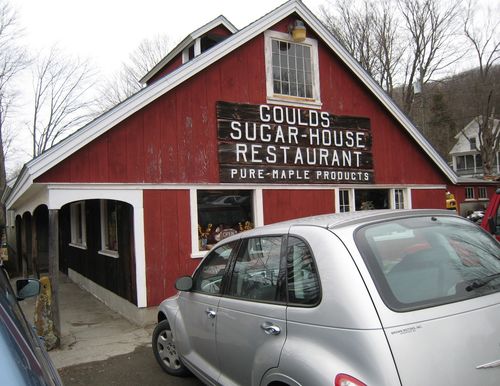
    In the 1960's, three Franklin County sugarhouses, Gray's in Ashfield, Davenport's and Gould's in Shelburne, began offering maple-syrup-laced breakfasts during the sugar season, an early foray into the now popular "agri-tourism."

    Of the three, only Davenport Maple Farm, up Little Mohawk Rd. off Route 2, still offers breakfast during the sugar season. (See sugar shack restaurants)  Gould's has ceased all operations for the present.

    Gouldsrestaurant

    Goulds.sugarshouse2
    Gould's Sugarhouse

    Evaporator
    The evaporator at rest

    Evaporator2
    Gould's evaporator in action

    Tending syrup

    Monitoring the syrup


    While Canada, mainly Quebec, produces 80% of the world's maple syrup and Vermont leads the U.S. with around 1 million gallons, Massachusetts, ninth in the nation, produces about 60,000 gallons, worth 5-6 million dollars, and interest in this local industry is growing.  Eighty percent of our 300 plus producers are located west of I-91. Sales of Massachusetts syrup are mainly within the state.  For more information visit https://www.massmaple.org 

                               Syrup flows from the evaporator

    Maple syrup production benefits the environment by preserving forests and woodlots, important habitat for birds and other animals.  By making commercial use of forested areas, sugaring saves them from other uses that might destroy the trees.  Sugaring preserves approximately 15,000 acres of open space in Massachusetts.  It also allows local dairy farmers to stay in business by giving them additional income.

    In addition to being delicious, maple syrup is high in antioxidants, minerals, especially manganese, vitamins, especially Riboflavin (B2), and low in fructose.  For recipes that use maple syrup, visit https://www.millbrookhouserecipes.com/maple-recipes/                

    Unfortunately, maple sugar production everywhere is is threatened by the invasion of the Asian longhorned beetle, which destroys hardwood trees, particularly maples.   It was  discovered in Worcester, MA, where 25,000 trees were destroyed to stop its spread.  Today officials urge people to keep an eye out for the pest and, most particularly, never to transport firewood from one location to another, but always to burn local wood.  

    Maple syrup production is also threatened by climate change. As winters become warmer, the season is more erratic and the length of the sap run less dependable.  But thanks to new innovations–visitors are more likely these days to see tubing instead of buckets–maple syrup production in the Northeast is higher than it's ever been, and for now there is an abundant supply for local consumers and tourists to buy and enjoy.


  • I was heartened to learn that author Ann Patchett does not use a cell phone.  I do, but rarely.  People watching is so much more interesting.  One Sunday in September I was breakfasting in a self-serve restaurant in Freeport, Maine, sitting across from a father and young daughter, most likely a divorced dad who had his daughter for the weekend.  After getting her some pancakes, the father proceeded to bury himself in his cell phone.  The daughter, too young for a cell phone, was bored and stared around the room absently, but without protest.  As I watched, the dad said not one word to her.  I wanted to walk over, throttle him, and shout: Speak to your daughter!

                Later that morning I sat outside an LLBean dressing room while my husband tried on pants.  A mother and her teenaged daughter sat across from me, both absorbed in their cell phones.  Each, evidently, found something of interest because at one point they exchanged cell phones.  Then the mom made a quick call, presumably to the family member in the dressing room.  Eventually a teenaged boy emerged and followed the two women away from the waiting area—immersed in his cell phone.

                Technology is supposed to make our lives easier, not swallow them.

  •  

    On our latest excursion to the Greenfield Garden Cinema we took in Captain Phillips, Paul Greengrass’ latest film, which retells the 2009 hijacking of the freighter Maersk Alabama by Somali pirates, its captain’s brave stand against them, and his tense rescue by a Navy Seal team.  The film has won much critical acclaim, and its editing will no doubt earn it an Oscar nomination and perhaps the Oscar itself.  Tom Hanks’ performance, which takes the taciturn Yankee captain from stoicism to complete breakdown after his rescue, may also earn an Oscar nod.

                But the film, though high drama, is not fully realized cinema.  Greengrass, who made United 93, another faithful reproduction of contemporary heroism, does little to transform his stories from news events into art.  Ron Howard’s Apollo 13, made long after that spaceship’s perilous rescue, also starring Tom Hanks (perhaps not coincidentally), makes a useful contrast.  Howard and his screenwriters lift Jim Lovell’s ill-fated space flight out of docudrama and embed it in a mythic context—Odysseus’ return to Penelope, Dorothy’s struggle to get home from an exotic and dangerous other world…  The film is structured around multiple ironies that build to the final one—the mission as a “successful failure”—and is laced with other recurring motifs (outer-space urination being one of the most obvious!)  Greengrass gives us finely observed characters, but little else to hang our cinematic hats on.

                Great editing and Hanks’ performance make Captain Phillips worth the price of admission, but, like so much contemporary news, it leaves one unsatisfied and slightly depressed.  How, one wonders, can people can exist in such poverty and anarchy as these Somali pirates?  (To his credit, Greengrass is uncompromising in his portrayal of their wretchedness.)  And while one is grateful for the Navy’s efforts, the sight of America’s overwhelming force and cutting-edge technology arrayed against the bedraggled beggars is more chilling than heart-warming.  The world’s inequalities are on full display in this film, with no resolution in sight. 


  • Kagoshima012.21

    My favorite city in Japan made the news a few months ago, following a burst of lava from the side of its volcano, Sakurajima, sited in Kagoshima Bay. Sakurajima has had small eruptions for some time now, which are of concern because a nuclear plant lies only 30 miles away. For me the concern is personal, for Kagoshima holds a special place in my heart that stretches back to childhood.

    It all began in 1957 when my parents took me to see Teahouse of the August Moon, a service comedy about the early days of the American Occupation of Okinawa. I adored it. (That Sakini, the Okinawan interpreter, was being played in yellow face by Marlon Brando went by me completely.) I watched my first grown-up movies (Oklahoma!, Tammy and the Bachelor) that summer, but in retrospect I realize that the trip to see Teahouse was meant mainly as a softening up tactic. A few weeks later, my mother confided that we ourselves would move to Okinawa that fall. I was thrilled.

    When did I become a Japanophile? Was it pouring over Little Pictures of Japan from the My Book House series (of which we owned every volume) or playing with the clamshell novelties my mother brought back from New York’s Chinatown that opened up into beautiful paper flowers when soaked in a glass of water? Didn’t all children at the time try to dig a hole to China (which, we were told, lay just below us on the opposite side of the earth)? Perhaps we were all incipient orientalists. But in my case, it lay very close to the surface.

    Eagerly anticipating a land of pine-covered hills and kimono-clad geishas, I was horribly disappointed six months later to find myself on a sub-tropical island, whose bright sunlight was blindingly intensified by the ubiquitous coral dust. A battle 12 years earlier had scoured the island, leaving much of it treeless. Pampas grass and sugar cane grew where vicious fighting once took place and often covered deadly unexploded ordinance. As ubiquitous as the coral dust were American military vehicles and installations. No pine trees lit by moonlight, no geishas, no soft breezes, no distant mountains. Teahouse, it turned out, had been shot on the Japanese mainland, not on Okinawa. (A recently constructed Teahouse of the August Moon did exist in Okinawa, but it had been inspired by the movie, not vice versa.)      

    Although the island abounded in ancient local arts, whose revival the American military government had encouraged (and—as per the movie—cricket cages were for sale in every local tchotchke shop), at nine I had no more ability to appreciate the local pottery and textiles than I had to discern Marlon Brando under his make-up. I longed for the classical arts and picturesque landscapes of “real,” Japan, land of lanterns, ukiyoe and fireflies.

    I was ecstatic, therefore, as I embarked with my mother and sister on my first trip to the main islands of Japan. We left on the overnight boat from Naha, Okinawa’s capital city, and landed the next day in Kagoshima, the southernmost port city of Japan’s four main islands. This time it was love at first sight. My mother had splurged and booked us into a genuine ryokan [Japanese inn]. Our tatami-mat-covered room opened onto an exquisite garden, and waitresses in kimono served our dinner and made up our beds, futon [thick quilts—the foam rubber kind hadn’t been invented yet] spread on the floor.

    The inn sat atop the kind of pine-covered hill I had been waiting a whole year to see and looked down over the city. Houses with black tile roofs lay below, a contrast to the red tile roofs of the more affluent homes in Okinawa, and they had good reason to be black. Sakurajima, sitting majestically in the distance, issued a thin plume of smoke from its conical peak. Smoke billowed, too, from the steam locomotives that pulled the trains that wound around the city in the valley below us.

    I had not been on a train since I was three and could only dimly remember the experience. Trains did not even exist in Okinawa, so I could barely contain my excitement, knowing we would soon be on that train, heading north to other cities in Japan.

    Watching the train and actually riding on it were two different things, however. These steam-driven vehicles had no air conditioning, and, it being summer, the windows were all open, allowing soot from the smokestack to blow in, covering passengers, seats, and floors alike. Tunnels, of which there were many, particularly on the tracks between Kyoto and Tokyo, proved particularly obnoxious as the smoke had nowhere to go except into the train. Passengers rushed to close the windows, rendering the carriage hot and stuffy. Mostly, though, the long slow journey—Kagoshima to Kyoto required an overnight trip—felt incredibly boring to a ten-year-old.

    At stations, hawkers filled the platforms, selling bento [lunch] boxes, constructed from the thinnest of thinly shaved wood, and tiny clay pots of tea, and passengers purchased these refreshments through their open windows. Once their contents had been consumed, the empty boxes and teapots, along with disposable chopsticks, all ended up on the floor of the train. Bored by the journey and IMG_3713 copy fascinated by the perfectly shaped clay pots, whose covers served as tiny cups and which varied in color, shape, and markings from station to station, I amused myself by crawling underneath the seats on the train’s dirty floor to collect them, much to our fellow passengers’ surprise and my mother’s chagrin. (Incredibly, this saintly woman, at my insistence, carried a very large basket of these discarded vessels back to Okinawa for me.)

    The little teapots and many other charms of mainland Japan notwithstanding, the trip was hard on one as young as I. The shrines and temples in Kyoto began to all look alike, and in Tokyo I spent a whole day in bed, possibly sick but probably just exhausted. We broke our return journey in the spa town of Beppu—no one had warned us how tacky spa towns in Japan can be—but the long trip south was as tedious as the trip north, and the inn in Kagoshima beckoned like a long lost friend. (Trains, I decided, were best experienced from that hill above the city.)

     Besides Sakurajima and the beautiful ryokan, Kagoshima featured Satsuma-ware, an elegant white ceramic with a crackled glaze covered by delicately painted bird and flower decorations. Shiny and colorful—in contrast to subtle earth tones of much Japanese pottery, including Okinawan—it captured my ten-year-old heart and has never lost its charm for me.

    Satsuma-ware derives its name from the feudal Satsuma Domain, which was ruled by the Shimazu daimyo from Kagoshima. Satsuma,
    Satsumaware2along with other southern provinces, led the revolt against the moldering Tokugawa Shogunate that produced the Meiji Reformation. Satsuma had, in fact, colonized Okinawa in 1609, making it a vassal state, although the island remained “officially” independent until 1879—one reason its culture remains so distinctive—when it was officially annexed to Meiji Japan.

    Two summers after that first rocky trip to mainland Japan, we returned to the U.S. (though not before docking in Tokyo Bay in the midst of the 1960 Anpo riots), but 1964 found us back in Okinawa.  The following summer my mother and I made a three-week trip to Kyushu, Honshu and Shikoku where we visited with family, friends, and an array of Japanese potters. Once again Kagoshima welcomed us and became the first stop on our pottery tour, where my mother hunted down the Korean potters whose ancestors had developed Satsuma-ware. The ryokan had been a one-time extravagance, so we stayed in a modern hotel with a large accommodating garden.

    Although the shinkansen [bullet train] now ran between Tokyo and Kyoto, Kagoshima to Tokyo still required an overnight journey, but diesel engines had replaced the steam engines, and, sadly, plastic teapots had replaced the charming clay ones formerly sold on station platforms. (Progress, as we know, is a two-edged sword.) I had looked forward to this trip as keenly as the first one, but, at 17, I was old enough to relish every aspect of it. Mist rising from acres of rice paddies graced by egrets, wooden houses with sliding doors and tile roofs, blocks of traditional wood-framed storefronts with their goods out front for customers to see and living quarters—with a cup of green tea for special guests—behind the store—today these things are mostly relegated to movies, museums and theme parks, but they were my Japan. In Shikoku, emerald green rivers ran down the mountains alongside the road our bus travelled. In Tokyo I joined Hiroko, my father’s former secretary, at her local public bath, and far up in the mountains of Kyushu, we visited potters in Onda, where all day long pestles, fueled by water flowing off the mountains, pounded clay. Thrilling but tiring, our trip ended once more in Kagoshima, where our gracious hotel and our ship home to Okinawa awaited us.  

    A year later I went to camp in Tokyo with my Girl Scout troop. We travelled TDY in an Army cargo plane, but when I stayed on after camp to visit Hiroko in Tokyo, I was back to using local transportation. I rode the shinkansen for the first time to visit friends in Kyoto, then, late one night, boarded the overnight train to Kagoshima. The next evening I met a family in the garden of the hotel where my mother and I had stayed the year before, and, seeing I was alone, they scooped me up the next morning and brought me to their home for tea and a visit before my boat departed. This would not be my last encounter with the warm hospitality of Kagoshima.

    I returned to the United States, went to college, became an art historian, and spent many years in Europe. Finally, in my mid-30’s I reunited with my Asian past when I began to study the filmmaker Yasujiro Ozu. (Ironically, in Okinawa Hiroko had taken my father to see Ohayo, one of Ozu’s late films, and he had described the delightful comedy to me in some detail. When, many years later, I finally connected the film he had described, which for a long time was marketed in the U.S. under the title “Good Morning,” to my beloved director, I asked my father if he remembered it. Although his account of the film had imbedded itself in my mind all those many years before, he had no recollection of it at all!)

    In 1991, I returned to Japan, having accepted a teaching job at a college near Nagoya. That summer, my husband and I travelled south, visiting friends and tourist destinations and managing to attend memorial ceremonies for the bombings of both Hiroshima and Nagasaki. From Nagasaki, we headed, for nostalgia’s sake, to Kagoshima to catch the boat to Okinawa. No overnight sleeper this time, but our destination nevertheless required us to travel all day by bus, ferry, and train. The city had modernized, of course, but its rolling hills and comparative lack of congestion made a soothing contrast to the crowded cities of Honshu. I purchased my own Satsuma-ware, and rediscovered the hospitality I had enjoyed as a teenager when the young host at our minshuku [Japanese-style B&B] insisted on performing a tea ceremony for us.

    We took the ferry to Sakurajima, but the majestic volcano seemed less benign than before. A thin layer of ash lay over the city and more thickly on the volcanic island itself. Several volcanoes near Nagasaki had erupted within the previous two years, and the ash around Kagoshima looked ominous.

    Sakurajima’s largest eruption in modern times actually occurred in 1914. Thirty-five people on the island died and lava poured into the sea, creating the land bridge to the city of Kagoshima that exists today. The city itself was covered in a thick layer of ash but otherwise remained intact. Subsequently, the volcano lay quiet until 1955 when small eruptions began, hence the smoke I witnessed first in 1957. In 2009 the volcano spewed lava and ash more than a mile above its crater and exploded most recently on Feb. 5, 2016. No one was injured and Kagoshima-jin [people] considered the 2016 eruption “average.”

    The threat posed by Sakurajima’s increased activity arises mainly from the fact that the Sendai nuclear plant in Satsumasendai, former Kagoshima017.2 copycapital of the Satsuma Domain, lies only 30 miles away. The first Sendai reactor was built in 1984, the second in 1985. (Japan’s first nuclear reactor was built in 1966.) After all of Japan’s nuclear reactors were shut down in 2011 in the wake of the Fukushima meltdown, Sendai was the first to re-open (2015). Why Japan builds reactors close to live volcanos or on tidal plains or builds them at all, given the likelihood of earthquakes, is a mystery beyond solving in this essay.

    Mainly, Sakurajima’s 2016 eruption reminded me of a city dear to my heart, which, like so much of Japan, lives on the edge of disaster with calm and dignity and grace.


    Sakurajima photographs by Steven Sternbach 



  • I once wrote a book about Wim Wenders.  It covered the first 20 years of his career, his breakout years in Germany, where he became one of the luminaries of the New German Cinema, which sought to separate itself from the mostly mediocre studio films of Germany’s postwar economic-miracle era, and his foray into American filmmaking, a rocky period which, nevertheless, culminated in the highly successful collaboration with Sam Shepherd on Paris, Texas (1984).  In a recent interview with NPR, Wenders noted that critics characterized these years by three A’s: angst, alienation, and America, and that’s not a bad summation.  The angst was always male; women, if they appeared in the films at all, inspired the intensest angst.  Relationships never worked out (on or off screen).  Wenders collaborated with Peter Handke, a more disciplined, but even more alienated artist, on many of the German films.  They were slow and contemplative and asked more questions than they answered.  Composed of inner journeys and outer landscapes more than real stories, they anticipated Wenders’ eventual turn to documentary, as many of them were already quasi-documentaries.  Kings of the Road (1976) documented the last of Germany’s rural movie theaters; Lightning Over Water (1980), supposed to be a collaboration with Nicolas Ray on a last movie, ended up documenting Ray’s last days, while The State of Things (1982), though fiction, chronicled the all-too-real dilemma of a film crew stuck with an unworkable project.

    Although preceded by two short films for French television, the delightful, Chris-Marker-like Tokyo-ga (1985), represents Wenders’ first notable foray into documentary.  The film explores idiosyncratic aspects of Japanese culture on the way to finding out more about Wenders’ hero (and mine), Japanese filmmaker Yasujiro Ozu.  Another decade of both fictional and documentary films followed, culminating in three Academy Award nominations for Best Documentary: The Buena Vista Social Club (1999), Pina (2011), and, this past season, Salt of the Earth (2014).

    With Salt of the Earth Wenders has achieved his most compelling work to date.  A chronicle of the life and work of Brazilian photographer Sebastião Salgado, the film takes us through Salgado’s short-lived beginnings as a revolutionary, which effectively exiled him from Brazil for a decade, his decision to give up a comfortable life as an economist to become a photographer, and the many photo projects he embarked on, projects that increasingly centered on the world’s marginalized.  The title “Salt of the Earth” is also the title of the 1954 Herbert Biberman fiction film about a strike by mine workers in New Mexico.  In early interviews Wenders sometimes named the Biberman film as one of his favorites, though his inward-looking early films gave little indication of own interest in such subject matter.  

    As chronicled by Wenders, Salgado’s photo career reaches a literal dead end when he photographs the Rwandan genocide and its less publicized aftermath, the death by starvation or disease of hundreds of thousands of Hutus, expelled from Rwanda when the Tutsis regained power.  Emotionally and artistically exhausted, Salgado returns to his father’s farm, where he grew up.  It too has been devastated—by drought and poor farming methods—but, together with his wife and life partner Lélia, Salgado successfully replants a rainforest, tiny tree by tiny tree, and the couple establishes the Instituto Terra (earth institute) on the farm, which has since become a national park, to teach others how to restore devastated land.  The reclamation project restores Salgado’s faith in living, and he goes on to become a nature photographer, giving to these images the same breath-taking depth, beauty, and grittiness that had characterized his earlier work, continuing to travel the world and risk his life—as the film documents when the crew has to crawl on its collective belly to elude a polar bear while Salgado photographs walruses in the Arctic.

    In creating the film, Wenders collaborated with Salgado’s son Juliano Ribeiro Salgado, who accompanied his father on the later expeditions recorded in the film, both to get footage for his own film and to get to know his so often absent father better.  The collaboration with Wenders, the young with the old, was, according to both men, difficult, and editing alone took about 18 months.  However, struggling through hours of footage and differing visions of how to shape the film eventually brought the depth, breadth, intensity, and plenitude that characterize the end product.    

    The film is structured around ever-widening circles of family (something a young Wenders found difficult to believe in).  First, there are the three generations of the Salgado family, central to which is the life-long love affair and partnership between Sebastião and Lélia that endures constant separation, yet survives and flourishes; next the human family that Sebastião photographs in all its variety, pathos, and savagery; and finally the family of all living things, at the same time fragile and resilient.  No more angst, alienation, or America.  Wenders confidently embraces the world in this rich, mature, affirmative work of art.

    Wim Wenders2 copy

    Wim Wenders, 1980's


  • This is a searingly beautiful account of Catherine Raven’s journey from alienation to healing through the ministrations of an unusual wild fox.  Raven is a survivor, a hardy soul from a dysfunctional family, highly intelligent, acutely sensitive, and brutally honest.  Trained as a biologist, she rambles through an eclectic sampling of natural history and her own observations while attaching them to carefully chosen if idiosyncratic selections from literature: Mary Shelley, Herman Melville, Lafcadio Hearn, and, especially, Antoine de Saint-Exupéry, whose Little Prince she reads aloud to the fox (!).  Why, she asks, is mankind so detached from the natural world?  Why do we push it away, relegating it to “scientific scrutiny” (and too often wanton destruction) instead of viewing and nurturing it with the totality of our humanity?  A question ever more relevant as we stand on the brink of losing so much of this world…  Raven’s helplessness in the face of a wildfire from which she cannot save Fox seems emblematic of our present struggles.  Her ability to move past his death and pull together the fragmented strands of her life should give us hope and, perhaps, suggest a way forward.


    Fox